Category Archives for Training

Husky-off-Leash

Siberian Huskies Off Leash

Is it a good idea to let your Siberian Husky (whether puppy or adult) off lead? The short answer is “no”, but the long answer is “maybe”. Here’s why…

Among many dog lovers, there is an opinion that huskies need to be walked only on a leash, and never let off the leash because this is an extremely “runaway” breed, whose representatives are prone to escaping at the slightest opportunity and never return. Of course, there is some truth in all this, as no smoke without fire, but the devil is not so black as he is painted.

Why do Siberian Huskies run away?

The Husky’s heritage is as a sled dog bred for endurance. That means they were “built” for running at a high pace over an extended period.

Furthermore, their natural prey drive means if a smaller animal is in sight there is a good chance they will run after it. That could be a squirrel, a cat, or a small dog. Whether they intend is to attack or just play with the other animal does not matter, they will just go for it. 

Compare this behavior, as an example, to a Labrador Retriever, who was bred to retrieve birds during a hunting expedition, returning the prize to their owner. Quite different to a Siberian Husky, who is mischievous, independent, crazy hyper, fun-loving, weird and so much more!! They were bred to RUN!!!

What this means for Husky owners is that their dog tends to have a one-track mind to chase. Dangers such as roads and cars may be oblivious to a running Husky. Even in a secluded area do you really want to spend the next few hours (or worse, days) searching miles around for your dog?

Probably not. For this reason, you need to consider the possibility that your Husky will never be allowed off-lead when outside your property. The risk of your dog getting into trouble is quite high.

Can you train a Husky to behave off-leash?

Just to let go for a walk off the leash, such a curious and adventure-seeking dog is the top of irresponsibility.

But if you are disciplined in training your puppy effectively and have your Siberian Husky come to you on-demand, you might just be able to pull it off. After all, Husky’s temperament is typically kind to strangers and you are not expecting your puppy to cause problems with people or other dogs.

By way of their independent nature, huskies can be stubborn to train. It takes many months and years to earn the respect of a Husky, and many dogs will still not obey their owners 100% of the time.

If your dog is off-leash you need that 100% assurance that your dog will follow your command, instantly. Exercising your Husky every day, providing the physical and mental stimulation to avoid bad behavior is key to earning this trust, and moderating the desire to bolt.

Where to train your Husky off-leash?

Have a look around for sporting grounds such as baseball parks or specialist dog training parks that are set up for off-lead training. That means no gaps, and a fence high enough for a Husky to jump over.

You might be lucky enough to have such a place near you. Ideally, as your confidence grows you want to try larger enclosed parks, preferably with people and dogs around.

What about outdoor areas with no fences and boundaries?

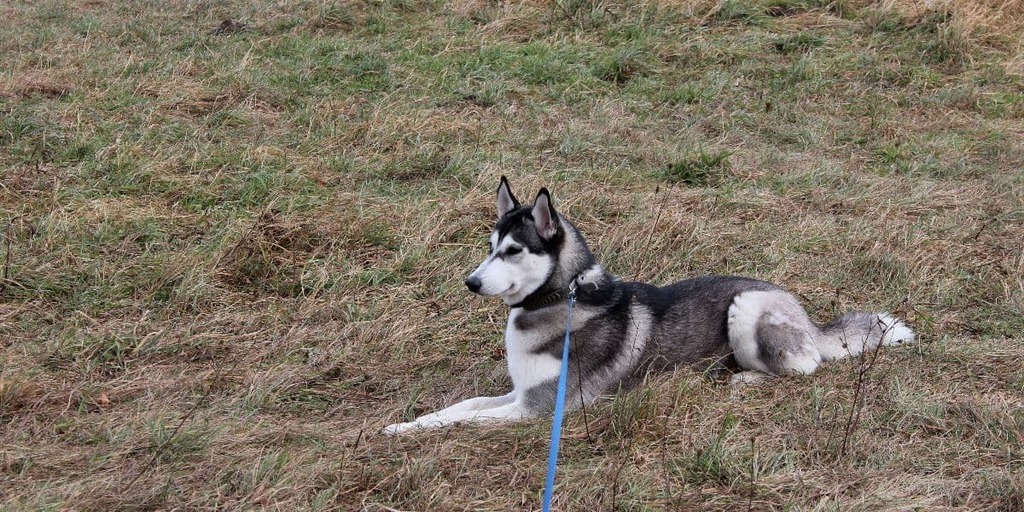
At the initial stage, always choose safe places, away from cars and highways. Take your husky into the open field once you gain enough confidence. This madness is worth seeing! Husky racing through space at sound speed.

Nature is the best place to practice obedience. He/she will be grateful to you. It is noticed that the Siberian rarely escapes from open, viewed space.

What do you want is to avoid the areas in which you might lose visual sight of your dog. Also places where small animals roam such as squirrels or cats.

How to train a Husky to come on request?

Husky recall training is the key to reaching the end goal of feeling comfortable having your dog off-leash. The ability to call back your dog on demand is critical to keeping him or her out of danger and not be a nuisance to you and others around you.

Siberian Husky on a leashYour work starts in your own yard. You should be able to call your Husky to you at any time and they will arrive. Initially, you might need to use food rewards to associate your words with the desired behavior. For example, if you yell “Cassie, come!” you want your dog Cassie to stop what is she doing, run up to you, stop and sit.

Start by reward the dog with a small food treat when they come. When they get the hang of that, only issue the treat if they stop and obey your “sit” command.

Eventually, you should be able to recall your Husky and not have to issue food rewards at all. This will take time, potentially many weeks or even months.

Use our ideas on giving feedback and general training tips to help get you started. Persistence and patience will be required, but the result will be a happier relationship between you and your Husky.

Once you feel your Husky is responding well to you, maybe you try recall training out of your yard. The key here is to change the environment and have your dog learn that your recall command applies everywhere, not just at home. This may require a few more food rewards. 

Siberian Husky should get used to freedom – and it is advisable to start this process in company with other dogs, who are already trained to walk without a leash and returning to the call of their owners (this does not necessarily have to be a Siberian Husky).

Then, as your dog settles in the company and begins to respond to the call to come back together with other dogs – and this will certainly happen because the dogs are pack animals and learn from each other very fast, you can proceed to the next stage – start letting the dog go off-leash, somewhere in the field or in a forest.

But again, it is highly desirable to do so in the company of other, already experienced and trained dogs. Call your pet along with the other owners calling their dogs – and be sure to positively reinforce the correct behavior. 

If you require more help in training your husky I strongly recommend checking Doggy Den’s online training.

What to do if your husky runs away?

What if your husky suddenly rushed after someone and does not respond to a call?

In no circumstances you should run after the husky dog. Huskies love to play catch-up and your dog will think that this is a game, and winning the race with husky you have little or no chance whatsoever.

The best solution in this situation is to call the dog and run in the opposite direction. As soon as your dog sees that you are running away, I assure you, she/he will run after you with a 95% probability.

However, there are always that 5 % chances, when your husky may or may not hear you, or still decide to run and mind their own business:). What to do in this case?

The best solution is to stay in place and continue to call your pet. Some “escapees” return within an hour to the place they left. Keep this in mind! If you run after him – there’s a great chance that you will miss each other when the dog runs up and decides to return to you.

The next very important thing to know when the dog returns, never to scold him – on the contrary, praise! After all, he returned to you, and about the fact that he ran away, he has forgotten already – the puppies have a short memory;))

And last but not least – the Siberian Husky can not get lost, they are well oriented, and definitely able to return to the house or the place where he ran away from you – but for this to happen, your husky should want to return to you, and this implies that he/she considers your house as his home, where he feels comfortable and safe.

Tips to prevent huskies from running away or get them home ASAP:

1. More exercise and impressions. The more exercise and impressions your dog will get, while interacting with you, the fewer reasons your dog will have to run away.

2. Let your husky choose the walk route 

During walks on a leash or without, sometimes let your husky choose the walk route – thereby you will find out which places your dog is most attracted to. This will give you a clue, to where you should look first in case your Siberian is gone;)

3. Explore your neighborhood and the surrounding area.

It is also advisable to explore your neighborhood and the surrounding area, let the dog roam around, and the further from your home, the better. 

4. Get a Personalized Dog Tag for your husky.

There are plenty of choices on Amazon and you can customize it on the spot while ordering. Dog tags work perfectly. This option is cheap, reliable, and operates regardless of how far your Husky might run away or any technical problems that might occur with your GPS tracker (if you have one). 

Believe me, there are enough kind people and just simple dog lovers in the world, who will call and delight you with good news, regarding your lost husky. 

 You may never reach the point where you are 100% comfortable letting your dog off-leash in urban environments but with a lot of practice, you can probably have your husky run around an open field and come back to you on demand.

Conclusion

Siberian Husky Off Lead in Winter SnowSo if you had visions of purchasing a Siberian Husky and having it follow you around and chase balls like a Golden Retriever, Labrador, or Border Collie, you need to re-think the situation. Most Husky owners will never let their dogs off-leash outside their homes. Sorry to disappoint but that’s one of the trade-offs of the breed! It isn’t cruel but to protect your dog from harm.

However, if you are disciplined to deliver consistent, regular recall training over the dog’s life you might just be able to let your dog off-leash in some environments. Use our training tips, particularly with positive feedback, and you will give yourself the best chance at success!

And if not? Well, we have some advice on leash training and what to do if your Husky is pulling on the leash.
how to crate train a husky

Crate Training a Siberian Husky Puppy

Bringing home a new Husky is an exciting time yet the responsibility of training them is huge. In recent years, crate training has taken off as an ideal way to help you train your hound into a well-behaved family pet. Used correctly, it can be a fantastic aid and speed up house training, limit destructiveness and create a little sanctuary your Husky can call home.

What is crate training?

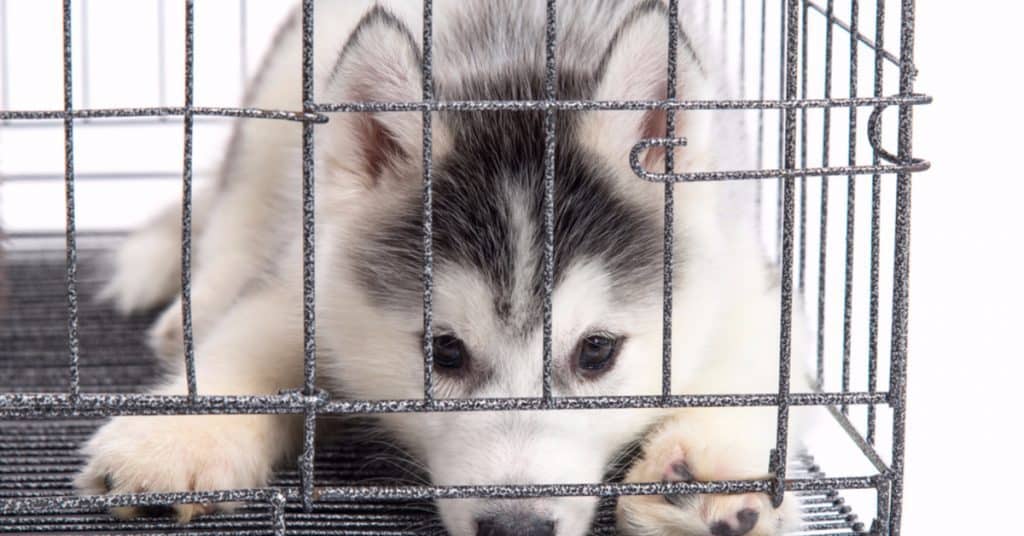
Crate training involves using a wire or plastic enclosure with a top and door, normally with a plastic-covered bottom. All-wire enclosures are popular as they are easy to clean and well ventilated, but predominately plastic crates are used for airplane travel. While either variety can be used, a Siberian Husky with a more nervous disposition (perhaps a rescue pet) may prefer an enclosed crate better. Avoid fabric type ‘crates’ because your Husky will easily chew through them.

The crate training itself comprises of getting your Husky used to spending time in his or her crate without getting anxious or upset.

Why perform crate training?

Siberian Husky in a CrateThere are several aims of using a crate.
The main one is that your Husky always has their own place where they feel safe and can go to at any time. When your Husky is a small puppy (admittedly this stage does not last long!), your house can seem large and daunting.

Using a crate provides a safe place for them to go back to that is familiar and secure. It can also help keep your puppy safe if you need to leave them alone for any period of time before they have learned what they can and can’t do.

Dogs are not really den animals, but with the right positive association, a crate could be a cozy place they are looking for and feel secure inside. If you are traveling with your Husky, or staying somewhere new, using a crate can be beneficial as it is an environment they are used to and somewhere they can feel more relaxed.

Additionally, using a crate can help alleviate behavioral problems. If your dog is destructive for example, crate training can stop them from damaging your home when you go out. However, although it can be used as an aid to training, it will not deal with the cause of the original behavior and this will still need to be addressed.

Finally, it is important to remember that the crate should be used as a positive training aid with your dog. Never use the crate as a form of punishment. Your Husky should also not be spending the majority of his time each day in his crate.

How to choose a crate and what size crate for husky?

The crate needs to be large enough so that your adult Husky can stand up, fully extend legs while lying down and turn around comfortably. A male husky would need one around 42 x 28 x 30 inches, although a smaller female may get away with one just 36 inches long.

A smaller puppy will not need so much room. If you are unable to buy different sized crates, use a partition to create a smaller area. A smaller space will aid house training as your puppy will be less inclined to mess where they sleep. Remember that if the crate is too big, that does not give a sense of security to your dog and does not accustom your husky to cleanliness and will lead to an ‘accidents’, especially when you start potty train your husky with help of using a crate.

Where to buy a crate for husky?

Crates are easily available and can be bought from any large pet store or online (for example at Amazon.com). As mentioned earlier avoid fabric constructions. Instead, look for an all-wire crate with a plastic bottom that makes for keeping things tidy and easy cleaning. We like this one on Amazon – iCrate Single Door & Double Door Folding Metal Dog Crate

When is the time to use a crate for a husky puppy?

The best time is when you bring a puppy to your house the first time. If you bought a puppy from a breeder, there is a high probability that he/she already knows what a restriction is. If the puppy is less than four months old, he should not have the problem of perceiving the cage as his “home”. If he is older, then it will not be so easy, but this can and should be achieved.

Where to place a dog crate?

My dog’s crate is in a corner of the dining room, away from heat and drafts. You can put yours in the corner of the kitchen, living room or in any other similar place where the family gathered and spend their time very often. Do not use newspapers in the cage; instead, place a piece of blanket or towel, or any other bedding that can be easily washed in the event of an “accident.”

How to crate train your Husky

If you are crate training your Husky as a puppy, the key as stated is to make it a nice, safe place for him to want to be. Hopefully, your puppy’s breeder will have given you something that smells familiar to them or take a blanket when you collect them and rub it on their mum before you leave. Place this in their crate with their new bed to make it smell familiar.

Inevitably your first night or two will be rather noisy as your puppy misses their littermates, but after you get through these things should get easier.

Siberian Husky in CrateVery important to make the crate a positive experience for them as much as you can. Let them have their meals in it, and encourage them to go in occasionally and reward them with treats (without shutting the door at first). Place a new toy in there for them. All in all, make it a place they are happy to be.

After a while, during the day you can start shutting them in for short periods too. Ideally, this can be when they are ready for a nap after playing or feeding. Place one or two treats in there, encourage them to sleep and close the door on them. Open it when he has settled. Always let him out when he is being good, and ignore him if he is being noisy. Talking to him or telling him off when he is misbehaving is still providing him with the attention that he is after.

You can start to gradually increase the amount of time they are left in, but do not leave your puppy in their crate for long periods of time; they will need to be taken outside regularly to relieve themselves. They should be allowed to sleep in their crate, but remember that as soon as they wake up they will need to be taken outside again.

Puppies are like small children, they have little self-control! Never introduce your husky to the crate by putting them in it and just shutting the door for long periods of time, they will find this very distressing.

After a time, you will find that your puppy is relaxed and happy to go into their crate when asked. This can be helpful if you need to go out and leave them unsupervised at home. Just remember, no husky puppy, or any dog for that matter, should spend long stretches of the day crated.

With adult husky’s crate training can be conducted in much the same way. Place a favorite piece of bedding in there, feed them in it and encourage them to go in for a treat. Again when they are nice and tired, start by shutting them in for short periods. Let them out and reward them when they are calm and quiet.

Finally, remember that your husky loves being around their family; they are very much a pack animal. They will be happier using the crate if it is not isolated and out of the way. Keep them nearby to help them relax. You will soon find that they take themselves off to bed when they need a nap!

Conclusion

Crate training your husky can help in many ways and is ideal in providing them with a safe, secure place where they can relax. As long as the crate is never used as a punishment it will be a positive addition to Husky’s life.

Need more help?

The Online Dog Trainer courses address various behavioral issues that you might be having with your dog. It’s the only dog training course we recommend. Crate training is just one part of an overall training strategy you should have.

Also check out our other articles on training that cover a range of topics such as feedback, potty training, leash pulling, and more!

Finally Gone to the Snow Dogs has a great video on crate training with additional tips:

Siberian-Husky-Pull-Training

Pull Training for Siberian Husky Puppies

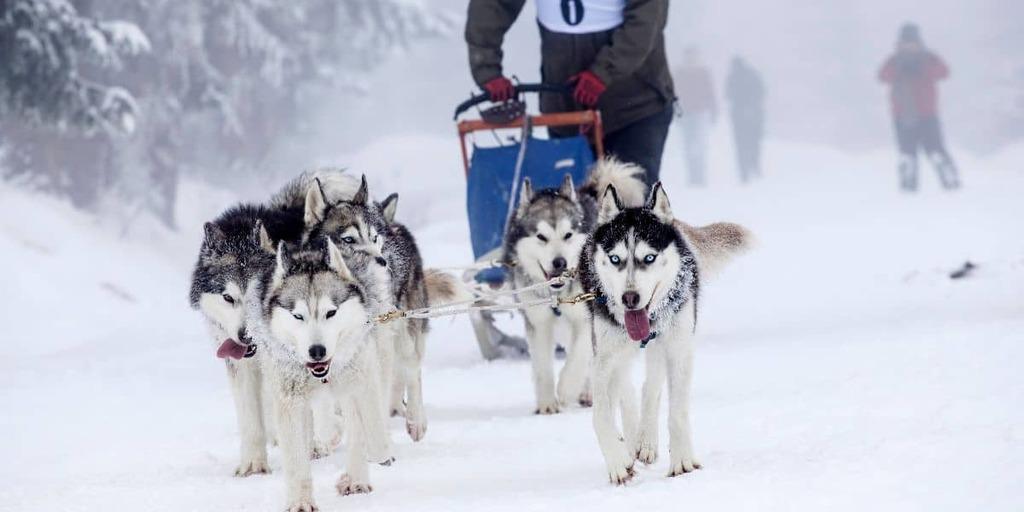
Interested in mushing with your Siberian Husky puppy? Whether that be the traditional sled-pulling, or some urban alternatives such as rollerblading, scootering, or pulling a cart, the training principles are the same. However, you just can’t get your nine-week-old pup to start pulling you along! You need to build up the skills and strength. Here is how to get started.

First, you need to get your Husky outdoors and accustomed to foreign surrounds. Basic harness training is essential – which you can read about in Harness and Leash Training for Siberian Husky Puppies. You need to have control over your puppy to go and stop on command, as well as move in a straight line forward.

You can start teaching some more commands at around 5 months of age. By this time we hope your puppy is growing in size, is used to being walked, and respects you as its master. By 9 to 12 months you can do short runs of less than a mile, and build up from there. You don’t want to put too much strain on a young dog while he or she is still growing and building bone structure and muscle mass. Just like humans, we go through growth spurts in our youth, but it isn’t until early adulthood until we start to build significant strength and endurance.

After start and stop commands, the next ones you want to introduce for mushing are:

  • Gee – pronounced like the letter ‘G’, which means turn right
  • Haw – which means turn left, and
  • Line Out – which means pull the line taught. Used when you are about to start moving forward from a stationary position.

At first, your Husky will not understand these commands. A lot of repetition will be required, combined with positive feedback when the correct behavior is made, to get the command to stick. Like any training this will take time and patience, so use our training tips and feedback tips to help the process.

Pull training with Siberian Huskies for sledding and mushingGenerally, you should avoid having your puppy pull any weight, or drag, while it is still learning these commands. Trying to teach too many new behaviors at once is confusing to the puppy, and probably frustrating to the teacher as well. Once you think your dog is getting the hang of things you can try pulling some very light loads. Some good examples are a water bottle, an old bag or pair of shoes, or anything else that is unlikely to hurt the dog if he or she suddenly stops and the object continues in motion towards them. Over the next year, you can slowly build up to heavier weights.

It is really important to keep an eye on your Husky and look for signs of exhaustion such as sweating, excessive panting, overheating, or simply not enjoying the activity. Training takes time and dogs learn at different rates.

If you are keen on having a working dog that pulls loads regularly here are some further resources to help you on your journey:

  • Seppala Kennels has a fantastic, in-depth article on sled dog training. This covers much more detail especially with respect to the equipment you might need.
  • You should look around your area for dog clubs. Not just Siberian Husky dog clubs but also sledding clubs, or just general clubs where you can hook up with others who can show you the ropes (literally speaking!).
  • The book Mush! Revised: A Beginner’s Manual of Sled Dog Training by Charlene LaBelle covers the basics and although you may have no desire to get into competition sledding, the topics discussed are still relevant to basic urban training.

Whether you have high hopes of winning the Iditarod, or simply want to give your Husky puppy the opportunity to have a go at what it was bred to do, we hope these beginner’s tips have been helpful to get you and your dog on your way.


Siberian-Husky-Leash-Training

Harness and Leash Training for Siberian Husky Puppies

We all know that exercising puppies is important, and Siberian Huskies are no different. You need to exercise every day, and from an early age. When it comes to walking and running, you are going to need to restrain your puppy with a harness or a leash. How do you start? Read on…

Start early

You can start exercising your puppy from an early age, for short periods, and work upwards from there. We have some specific information on how much to exercise in our article Exercising a Siberian Husky Puppy. You can and should start walking from an early age. Eight weeks is ideal, or whenever your Husky has been given its vaccinations, both of which should approximate when you pick your puppy up from the breeder.

Leash or Harness?

Some trainers suggest a leash is best because it gives stronger physical feedback to the dog if they pull – i.e. a choke. Others suggest a harness for that very reason – it is more gentle while still achieving the primary objective, which is to keep the animal restrained. Whichever you go with you start with short walks while your puppy is small and still building muscles. Over the first year, you can gradually build up to longer (1 hour) exercise sessions.

If you have aspirations to have your Husky pull a load (sled, sulky, or yourself on rollerblades, a bike, or scooter) then a harness is the way to go. Even though you won’t have your puppy pulling loads early on, it can get used to the sensation of having a harness around its chest. There are plenty of harnesses on the market to choose from. We like this one from Amazon. Very good quality harness with really soft pads. Size L fits perfectly for my 51 pounds Siberian friend. Also, I love reflective straps, which is glowing at night. 

Here is a short video showing how to fit a typical dog harness:

Early Training

Find an open area free of human and animal distractions, and keep your Husky on a leash at all times. Huskies have an inherent desire to take off and run – and if given the chance – probably will!

Patience is the key to effective training. You need to take your time and give plenty of positive feedback to encourage effective behavior.

Here is how you might go about teaching your Husky to move with you:

  1. Walk slowly. Your dog will probably want to run in all directions. If any of those directions is not forward, stop and let the dog pull on the lead until he or she figures out they aren’t going anywhere.
  2. Work up to walking for a dozen or two yards then stopping. Give positive feedback in the way of praise, cuddles, and maybe a food treat.
  3. Repeat until your dog gets used to the idea of walking in straight lines, reducing the food treats but keeping up non-food appraisal to encourage this behavior.
  4. Work up to longer walking lengths as your puppy grows in confidence, ability, and endurance.
  5. If you feel the puppy has the strength you can try some running for short bursts, evaluating how it feels afterwards. If overheating or exhaustion seems imminent then, of course, take it easy and try again another time.

You might want to consider inventing words for “go” and “stop”. Ideally you choose words not likely to come up in everyday conversation, so that your Husky understands these are special words reserved just for them. “Yup!”, “Wah heed!” or “Giddyup!” might be words to go. For stopping, “Woah!” is an obvious command to bring your Husky to stop. It doesn’t really matter what the words are as long as:

  • They are short
  • They sound distinct
  • You can yell them out

Non-movers

If your dog doesn’t want to move, then walk alongside it. Try holding a small food treat at nose height to encourage moving forward.

Some puppies want to move, some don’t and it will take time to learn this behavior. Just be patient and don’t stress if it takes a few weeks or months for the dog to get its confidence up! Lots of positive feedback will help.

Watch for over-excitement

In your training you will probably notice your puppy getting over-excited at times. You should look for the warning signs leading up to this behavior, such as howling or barking, a change in movement, a desire to jump or run. When you see this behavior coming up you know to pull the leash back in a bit and slow down. You want to make sure you are in control and that your puppy knows it. There is no need to penalise the puppy with negative feedback. Just stop and be quiet until your puppy settles down.

Ready for more? Check out Pull Training for Siberian Husky Puppies if you want to start pulling a sled, a cart, or yourself!

Having trouble with an over-excited Husky? We have some tips for leash pulling problems here.

Exercising-a-Siberian-Husky

Exercising A Siberian Husky Puppy

Siberian Husky puppies desire a lot of attention to prevent boredom. Exercising them is a great way to help them stay entertained, not to mention grow up healthy, but how much exercise should they get? Here are our top five tips on exercising your Husky puppy.

1. Exercise every day

It is really important that Huskies, particularly younger ones, exercise every day. This is a form of training where you teach your puppy healthy habits, discipline, and encourage socialization. Doing it every day keeps the routine up: if you miss a day you will ‘feel’ it and not lapse into more than a day of inactivity. Your puppy will love you for it as well. Exercise helps build their strength and endurance – characteristics that Siberian Huskies are bred for.

2. Go slow for the first year

Your Husky grows rapidly during its first few months, reaching adult size after about a year. The joints, ligaments, and muscle mass of your puppy need time to develop, so don’t overdo it early on. If you push too hard, especially with repetitive-motion activities such as walking and running, you might put too much stress on the puppy’s ligaments which can lead to soreness, tiredness, and inflammation.

3. The 5-minute-month rule for walking

Walking is a great exercise activity: it is free, easy, and good for both your puppy and yourself! We recommend the ‘5-minute-month’ rule:

Walk your puppy each day, increasing 5 minutes each month.

For example, if your puppy is three months old, walk him or her for up to 15 minutes every day. If your puppy is six months old, walk up to 30 minutes every day. If you follow this simple formula you will build up the necessary walking exercise gradually and in sync with your puppy’s natural growth over the first year.

After your puppy reaches his or her first birthday, you will be up to an hour of walking each day and can stay at this level. You might also graduate to jogging or running, or go for longer sessions, but only if your dog is used to walking and ready for the extra effort.

Exercising a Siberian Husky with toys and playtime4. Any time is playtime

15 minutes for a puppy does not sound like much, and it isn’t. However, you can take on other exercises in the form of playing games. Simply ‘playing ball’ with your puppy will mix up the physical movements: starting, sprinting, slowing, stopping, turning, etc. You can easily squeeze a few minutes in here and there of play to fill out the day and tackle boredom. Check out my Five Play Time Ideas for Husky puppies, to help fight the boredom of your dog. 

5. Stay cool

You know already that all dogs need clean drinking water available at all times to stay hydrated. The coat of the Siberian Husky might be dense but this also acts as an insulator in warmer weather, helping to regulate body temperature. So although the Husky might have originated in arctic climates, they should do fine in warm weather. Just make sure water is on hand, and if your Husky shows any signs of tiredness, take it easy. If you live in a hot environment you might want to consider walking your puppy in the morning before the heat builds up, and makes everyone just want to laze back and go to sleep.

If you start slow and build up exercise over the first year of life, mix in lots of play, and remember to keep your puppy hydrated, you will give your puppy a great start to a long healthy life. Just as important, you will get some exercise out of the deal as well!

Husky-Potty-Training

Housebreaking A Husky Puppy

If you would like to keep your Siberian Husky puppy indoors at times, then housebreaking is an early and essential training activity to perform. Whether you call it housebreaking, toilet training, or potty training, all Husky puppies can be trained to do their business outside, and not all over your nice clean floors.

When to start potty training husky puppy?

You are probably going to start housebreaking your Husky puppy at around 8 weeks old (2 months old). It is about this time that puppies develop muscle behavior to control themselves. Attempting to train younger puppies could prove futile. This will be amongst the first formal training you will do with your puppy and if you can get this right, you will earn his or her trust for future training.

Find a spot

Head outside and find a spot in the garden where you would prefer your dog to do its business. Your puppy will prefer to return to a spot that it has already ‘marked’. Make sure it’s out of the way of human foot traffic so that you don’t start stepping in things you don’t want to!

Have realistic expectations

Housebreaking can take a little time. You should hopefully start seeing results after a couple of weeks, but if not do not give up! Siberian Huskies are independent dogs and can be a little stubborn to train.

Once the routine is setting in there is likely to be occasional accidents for a little while longer. You need to be patient.

Also be aware that puppies are growing in their first few months – which means lots of food going in, and a lot has to come out!

Crate Training

A Siberian Husky Puppy on the grass outdoorsA dog crate is a closed container (typically plastic) that the dog can be confined to. Think ‘cage’ but use the more politically correct term ‘crate’. Don’t worry, crate training is recognized by the Human Society as an effective aid to housebreaking a pet.

The crate will be used as a training device for short periods of time. It is most definitely not a jail used to punish your puppy! The purpose of the crate is to confine your dog when you can not keep an eye on it, such as doing a chore around the house or ducking out for an errand. Because of the likelihood of the dog resting or sleeping in the crate, they are unlikely to do their business in there. If you let your puppy roam the house they could make their ‘deposits’ anywhere they feel like it.

Obviously you need to get a crate large enough for your puppy to fit in to, with room to grow. For a Siberian Husky that might mean going for an extra-large sized crate. You also might want to floor the crate with newspaper or absorbent material to aid in any little mistakes. A small amount of water and a toy could help comfort your pet. Huskies might be used to the cold but if you have a spot in the house that isn’t too drafty that would be ideal. They prefer a relatively warm and still place to rest.

Initially, you might only keep your puppy in the crate for 30 minutes. Over time, say from 8 weeks to 18 weeks of age, you can build up the maximum confinement from 30 minutes to 5 hours. That is approximately an extra 30 minutes each week.

After opening the crate, put a leash on your puppy and take him or her out to ‘their spot’ in the garden. They might not need to use it but they will learn the routine of restraining themselves while indoor and relieving outdoors. If you would like to know more read our full article on How to Crate Train A Siberian Husky Puppy.

Positive feedback only

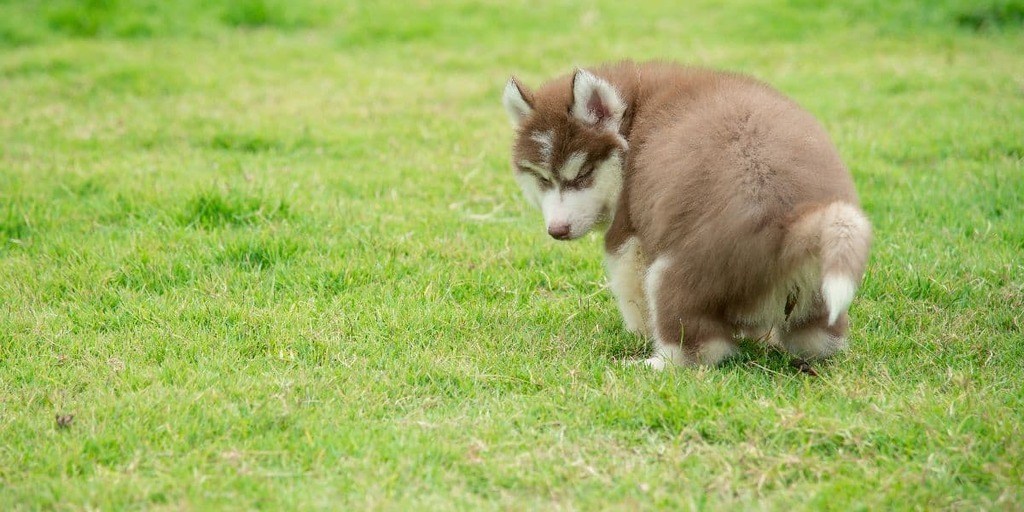
If you see your puppy begin positioning itself to do its business, a firm ‘NO!’ will grab the dog’s attention. You can pick your puppy up and move him to the spot outdoors to complete the job.

After your puppy does its business be sure to give strong positive feedback – ‘good dog!’ with scratches behind the ear and cuddles. This should be done immediately (within seconds) so that the encouragement is linked to the behavior.

Avoid negative feedback – the added attention will confuse the dog. If a mistake is made, never push your dog’s face into a ‘mistake’ made indoors. The puppy doesn’t know any better while it is learning. Just take your dog outdoors to remind him or her of their place, and in your own time quietly clean up the mess indoors. You can check a more detailed explanation on positive feedback right here – Feedback When Training Husky Puppy

Watch the schedule

Cute husky puppy outdoors on the grass

You will probably notice that your puppy likes to relieve him/herself when it wakes up, after meals, and perhaps after exercise. You can aid in the training by taking the puppy out to its spot after these times to encourage routine behavior.

If your puppy shows signs he/she wants to head outside, that’s great! They are learning. So take them out, let them do their thing, and again lots of positive encouragement. You might need to do a few trips out at night but rest assured, as the puppy grows larger and behaviors are learned, they will be able to restrain themselves for longer periods of time.


That’s pretty much all there is to it! Start at around 8 weeks, and use a crate for 30 minutes at a time, adding 30 minutes each week up to 5 hours. Give lots of positive feedback, no negative feedback, and most of all, be patient. The effort you put in now will pay off for the life of your Siberian Husky puppy.

Still need more help?  Check out Doggy Dan’s online training course. We found it is very easy to implement and perfectly suitable for our huskies. They currently offer a variety of options, starting from 1$ trial for 3 days and also a yearly subscription for nearly 190$. Here’s one of his training video to give you more ideas of how to effectively potty train a puppy: