Tag Archives for " brushing "

Huskies-in-hot-climate

How to Care for Huskies in Hot and Tropical Climate?

Although the Siberian Husky's origin is in the incredibly cold, icy environment of Siberia, they can and do live in warmer environments. Whether it be a tropical environment such as Singapore and the Philippines, or a dry heat such as outback Australia, a Siberian Husky can live a long and happy life.

There are a few things you first need to know before raising a Husky in such an area to maintain the health of your dog:

1. Keep the coat

Whatever you do, keep the Husky's coat and do not shave them! The hairy coat, although thick, actually insulates the animal from direct heat. If you remove it, your dog will not be able to regulate its own temperature and become very sensitive to the warmth of the sun.

Siberian husmy on the boat in Dubai, wearing red lifejacket

Siberian Husky in Dubai

2. Regular brushing

Regular brushing of the coat will evenly distribute oil secreted by the skin, along the length of the coat, which will remove dust and dirt and also clear away dead and stray hairs. This will ensure effective circulation of the air in the skin, which will keep your puppy happy and not overheat. In a lot of cases, an increase in body temperature is the result of poor hygiene, matted, and dirty hair. To get a clear idea about which brush to use and how to groom a husky, we have more information available at our grooming guide.

3. Exercise out of the sun

In warm environments, the day can heat up quickly in the morning, and remain hot until sunset. You should consider exercising your husky early morning and later after sunset when it is coolest. Be mindful of the intensity of exercise, especially for puppies and mini huskies who can not sustain long playtime sessions without a rest. Your Husky might find it easier to have two shorter walks a day, rather than one long walk.

4. Stay cool during the day

Whether you are at home or not, your husky needs to stay cool. In hot environments that might mean a room that is cooled or air-conditioned, or at least very well insulated from the heat. It is probably not enough to leave a Husky in a shaded area if that is only marginally cooler than a sunny area. Take the hint: if your dog howls to be let inside to where it is cooler, then that could be a sign is too hot outside for your husky.

5. Other things to keep in mind

  • Concrete and brick floors and walls can absorb a lot of heat and radiate it out for days. Your dog might feel better lying on wooden or some insulating material that will not retain so much heat. This especially goes for the dog's sleeping area or kennel.
  • Don't leave your dog in the car! A car's temperature can escalate to extreme levels in just minutes. If you wouldn't leave your child in the car then it's no place for a dog either.
  • If you live in a hot climate, you better purchase a husky puppy from a local breeder, as they already adapted to the local climate. Yes, there are even husky breeders in Hawaii where you think Huskies might struggle. Check out Facebook where some groups are being formed such as the Siberian Husky Owners of Hawaii to gain more information.
  • Keep in contact with your local Siberian Husky club or breeder who can give you some further advice specific to your environment

How to Cool Down a Husky?

Cooling mats

The cooling mats seem to be very helpful for those who live in a hot weather environment. I found Arf Pets Pet Dog Self Cooling Mat Pad work the best and our huskies love to chill on one of those. For the best results, place the cooling mat under the air conditioner.

Frozen treats in ice

Tip: ice cream containers are great to freeze large ice blocks.

I found KONG  to be a great toy for our huskies, to keep them entertained and cool at the same time. Just stuff it with your dog's favorite treats, like bananas and peanut butter, and keep it in the freezer for a few hours.

Kiddie pool

Fill it up and position it in a shady area or you can add some ice to keep water cold. Dogs love to jump in and out for a quick cool-down. There are plenty of options on Amazon and I was looking for something that I can use not only as a dog pool but outdoor water pond, sandbox, or kidlle pool. lunaoo Foldable Dog Pool is what serves the purpose for me and my pooch. 

Clean, cool drinking water

Seems like obvious advice, but a lot of people keep forgetting to keep the water cool. Keep it in a shady place so that it doesn't heat up.

Conclusion

Raising a Siberian Husky puppy in a warm or tropical climate is not difficult and just requires some common sense. Shade and cool during the day, exercise on the fringes of daylight, and lots of water to cool down. It might not be the environment the Husky was bred for, but your dog can and will survive if you give them a helping hand.
Husky-Grooming

Siberian Husky Puppy Grooming

Siberian Huskies are surprisingly good at taking care of themselves, licking themselves clean much like cats. However they do need particular attention paid to the coat when they molt, plus a regular grooming session once a week can help keep your Husky puppy looking fabulous. And who doesn’t want a fabulous-looking Husky?

Grooming For Young Husky Puppies


It is really important to start grooming Siberian Huskies early in the puppy stage. Their coats develop within weeks of birth. Also in the first 12 weeks of their life, they are most accommodating in learning new behaviors and routines that will last a lifetime. However if you have adopted a dog that has grown out of its younger puppy stage, it is never too late to start!

How often should you groom your Husky?

Once a week, for the life of the dog, you should do some basic grooming. It is important to stand the dog up to get it used to be groomed in this fashion. A standing dog makes it much easier for you to get through your grooming tasks efficiently and effectively.

A weekly brush of the coat will help keep it neat and tidy and dislodge any loose hairs or dirt that might be stuck in there. Brushing also helps avoid matting. Matting is likely to occur if you don’t brush your dog, and he or she likes getting wet in the rain, snow, and ice. You can find more tips about brushing, as well as our favorite tools we use right here – “The Best brush for Huskies

Molting

The molting (hair shedding) process usually happens once a year as the weather starts to warm up in spring and summer. Some dogs might shed twice a year, and some none at all, depending on the environment. A young Husky puppy is unlikely to fully shed in its first summer but might drop a few hairs around. When your puppy reaches 10-14 months old a major shedding will occur as the “baby” coat makes way for a thicker adult coat.

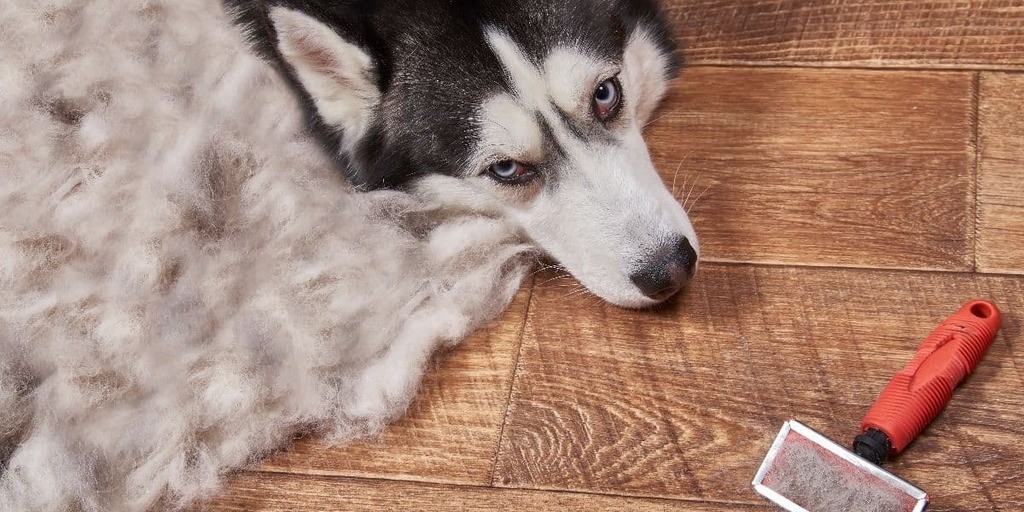
The molting process will typically start with a few sprinkles of fur dropping loose before the real action begins. A Siberian Husky will shed a lot of hair. A LOT. The bigger the Husky is, the more hair it will shed. If you have ever seen how much wool a sheared sheep gives, you are on the right track.

You will need out your Husky with some brushing. You can start with a larger, wide-toothed comb and brush out as much loose hair all over the body. Look for a comb or rake with rounded teeth (like this one  –PawsPamper Extra Wide Undercoat Rake) to avoid scratching the dog’s skin. You can use a fine-toothed comb for the head and neck areas where the fur is thinner.

Here is a video that shows just how much effort is needed to keep your Siberian Husky looking good, and how much hair can be shed in just one grooming session:

Washing

Most owners will only give their dog a bath once a year, after shedding. You could get your dog professionally washed, or you could take your dog down to a local hydro-bath to do it yourself.

If you have the space you can do it at home – just make sure you use a shampoo formulated for pets and follow the directions on the bottle. After washing you may towel-dry your Husky and, if you feel it is necessary, a light blow dry with a hairdryer at its weakest heat setting.

After the dog tries this is a great time to apply any flea, tick, and other parasite controls that dogs in your area require.

Other Grooming Activities: Eyes, Ears, and Nails

For the eyes simply grab a damp cloth to wipe the area clean of excretions, dirt, etc.

For the ears check once a month for signs of infection, mites, or other parasites. Any redness, discharge, or unusual odor will require a visit to the vet to check it out. There are also ear-cleaning lotions available that you can apply yourself if you want your Husky to look its best.

Nail clipping needs only be done from time to time. Once a month have a look and see if the nails need a trim. It really depends on the environment your dog is into whether nails are under control or not. Like all grooming, the earlier you start the better. You can start clipping the nails of a puppy at just 4 weeks old to help it get used to the sensation of the clippers.

Things To Avoid 

  •   Over-washing your Siberian Husky is a no-no. Oils secreted by the skin help protect the dog. Bathing will wash those oils away. A bath just once or twice a year is fine, or of course if your dog finds its way into something really messy and needs a helping hand.
  • Shaving the coat of your Husky is also to be avoided. The outer coat helps repel water, whilst the inner softer coat insulates the dog from both the heat and the cold. Let the coat do its job and you will have a happy Husky.

Finally, like all pets, clipping whiskers is not necessary. The dog doesn’t like it.

Your lovely young cute Siberian Husky puppy is going to molt. You can not avoid it, so get used to it! Importantly, start with some basic grooming as early as possible so that your puppy gets used to being handled. You might have to brush and vacuum up the hair left behind, but think of it this way: at the end of the molting process you are going to have a dog with a lovely coat to protect him or her for months!